Cultivating a Culture of Compassionate Candour

Say what needs to be said.

The Problem

The vast majority of teams we work with have room to improve when it comes to candour and psychological safety. Many team members don't speak up enough, choosing to stay polite and comfortable. Others speak up freely, but do it in such a way that it discourages others from following suit.

Research shows this undermines performance, decision making and innovation. The hard part is actually improving it.

The Insight

The answer is for the leader to take a systematic approach to creating an environment where everyone speaks up with respect and empathy.

They need to role-model constructive speaking up, invite others to participate and, perhaps most importantly, respond well when others demonstrate the courage to be candid. We call this Cultivating a Culture of Compassionate Candour.

The Program

In this program leaders and teams learn a practical process for increasing candour and psychological safety, and we practise it in real time. Michelle Rushton and Shaun Kenny, founders of People of Influence, help teams build this as key to building an Extraordinary Team.

Watch
What is Compassionate Candour?

The research is compelling. When Google's Project Aristotle measured psychological safety, as defined by Harvard's Amy Edmondson, they found it to be the single biggest differentiator of high-performing teams, and candour is strongly linked to better performance, higher engagement and faster innovation.

Candour on its own can feel harsh. Compassion on its own can avoid the truth. Extraordinary teams do both at once, so people can be honest with each other and stay connected.

Key Outcomes

What your team walks away with

01
Know what great looks like
The team understands what Compassionate Candour looks like and why psychological safety underpins high performance.
02
See where they stand today
Leaders measure the current level of candour and psychological safety in their team with the Extraordinary Teams questionnaire.
03
Strategies they can use immediately
The four steps to increase candour, and how to balance candour with compassion, ready to use straight away.
04
Practise the skill for real
The team practises being Compassionately Candid in the room, through activities and real scenarios.
05
A toolkit and an action plan
The team leaves with practical tools and the norms and conversations it commits to.
06
Nudges that reinforce over time
Nudges that keep candour alive long after the session.
The Diagnostic

Measure it with the Extraordinary Teams Diagnostic

Candour is one of the four key elements we measure with the Extraordinary Teams Diagnostic. It gives your team an honest, anonymous read on how candid and psychologically safe it is today, and where to focus.

Where the team stands
An anonymous measure of Candour and psychological safety across the team, so the important gaps are named.
The full picture
Candour is measured alongside Trust, Alignment and Execution, the other elements of Building Extraordinary Teams.
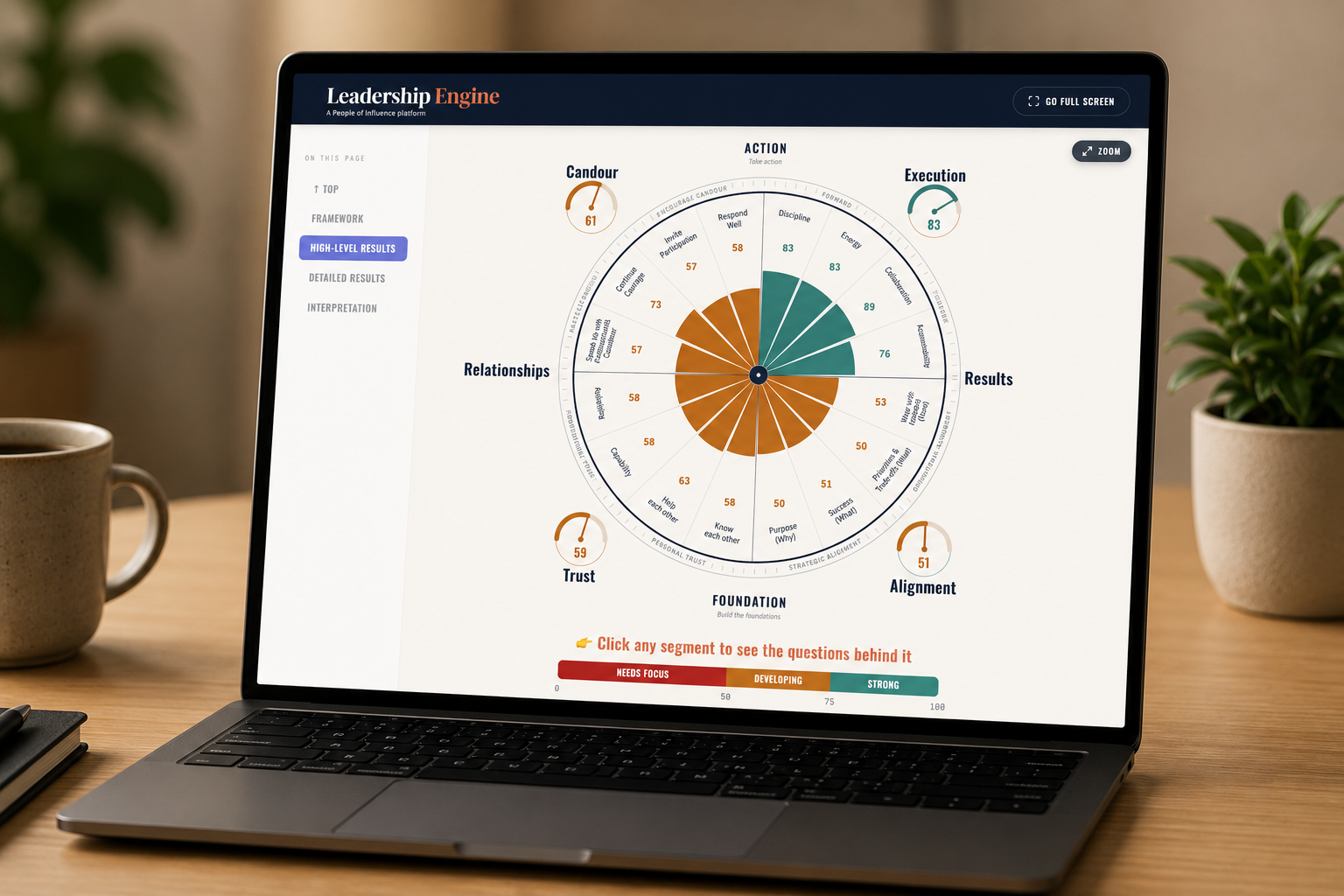
The Extraordinary Teams Diagnostic report shown on a laptop
Session Flow

How the session unfolds

An interactive team session, built around activities, discussion and skills practice.

1
Why candour matters
The research on candour and psychological safety, and the cost to a team when the important things stay unsaid.
2
What great looks like
Example scenarios to understand how to strike the right balance between compassion and candour.
3
Hold the mirror up
Through the Extraordinary Teams Diagnostic we see what the level of candour and psychological safety is in the team (lagging indicator), what behaviours the leader and team are engaging in (leading indicators) and the causes of any candour reluctance (diagnosis).
4
How to shift the culture
The practical four step process for increasing candour in a team: Setting the Stage, Inviting Participation, Speaking Up, Responding Appropriately.
5
Setting the Stage
Together the team crafts a binding behavioural statement that explains why candour is critical to their work success.
6
Speaking up
Building the confidence and learning techniques to raise challenging issues and question the status quo.
7
Responding appropriately
We learn how to respond in a way that is both honest and strong, yet encourages further candour from others.
8
Practise in real time
Activities and real scenarios, so the team practises being Compassionately Candid with each other.
9
Make it real
The team commits to the norms and conversations that will keep candour alive after the session.
10
Embedding
Over the following weeks to months: behavioural nudges, facilitated peer group coaching, individual coaching - a range of options depending on the engagement.
Format & Delivery

Shaped around your team

Duration
2 hours, half day or full day
Delivery
In person, ideally
Audience
Usually with an intact team and their leader. Can also be part of a leadership program.
Two ways to work with us

People of Influence is the consultancy through which Michelle Rushton and Shaun Kenny deliver leadership programs, team offsites and impactful conferences.

Contact People of Influence →

Leadership Engine is our proprietary platform for measuring and improving leadership effectiveness with diagnostics, dashboards and behavioural nudges.

Visit Leadership Engine →

